

Food Allergy Conundrums: Milk allergy and lactose intolerance – clearing up the confusion
by Ingrid Roche *
You may find that staff, patients and residents are often confused about the difference between cow’s milk allergy and lactose intolerance. This confusion can lead to the wrong diet type being ordered, which puts people with milk allergy at risk, or an over restricted diet for people with lactose intolerance. In fact, it is one of the most common mistakes made in the allergy foodservice landscape!
Here is what staff working in health care need to know about milk allergy and lactose intolerance:
About milk allergy:
People with cow’s milk allergy can have a life-threatening reaction to any food that contains milk or dairy. They are allergic to proteins in cow’s milk, lactose free milk, sheep’s milk and goat milk.
People with milk or dairy allergy must strictly avoid milk in foods because they may react to very small amounts of milk. Their food must not be contaminated with milk.

Reactions to milk or dairy can be life-threatening.
Food choices for milk allergy:
People with milk allergy must avoid all animal milks, yoghurt, cheese, cream, ice cream and any foods that contain milk or ‘may contain’ milk.
People with milk allergy must not have any lactose free products because they will react to the milk protein that is still in lactose free dairy foods.
They also need to avoid foods that say ‘may contain’ or ‘may be present: milk’.
They can have alternative (ie dairy free) calcium fortified milks such as soy, rice, oat, almond or other milks if they are not allergic to those foods.
Foods labelled as ‘vegan’ often have ‘may contain milk’ statements – if they do, these food should not be given to someone with milk allergy.
Long term patients and residents with cow’s milk/dairy allergy should be reviewed by a dietitian to make sure they are getting enough protein, fat and other vitamins which they miss out on when they cannot eat dairy foods. This is important for all age groups. Milk alternatives are not always an adequate nutrition replacement.
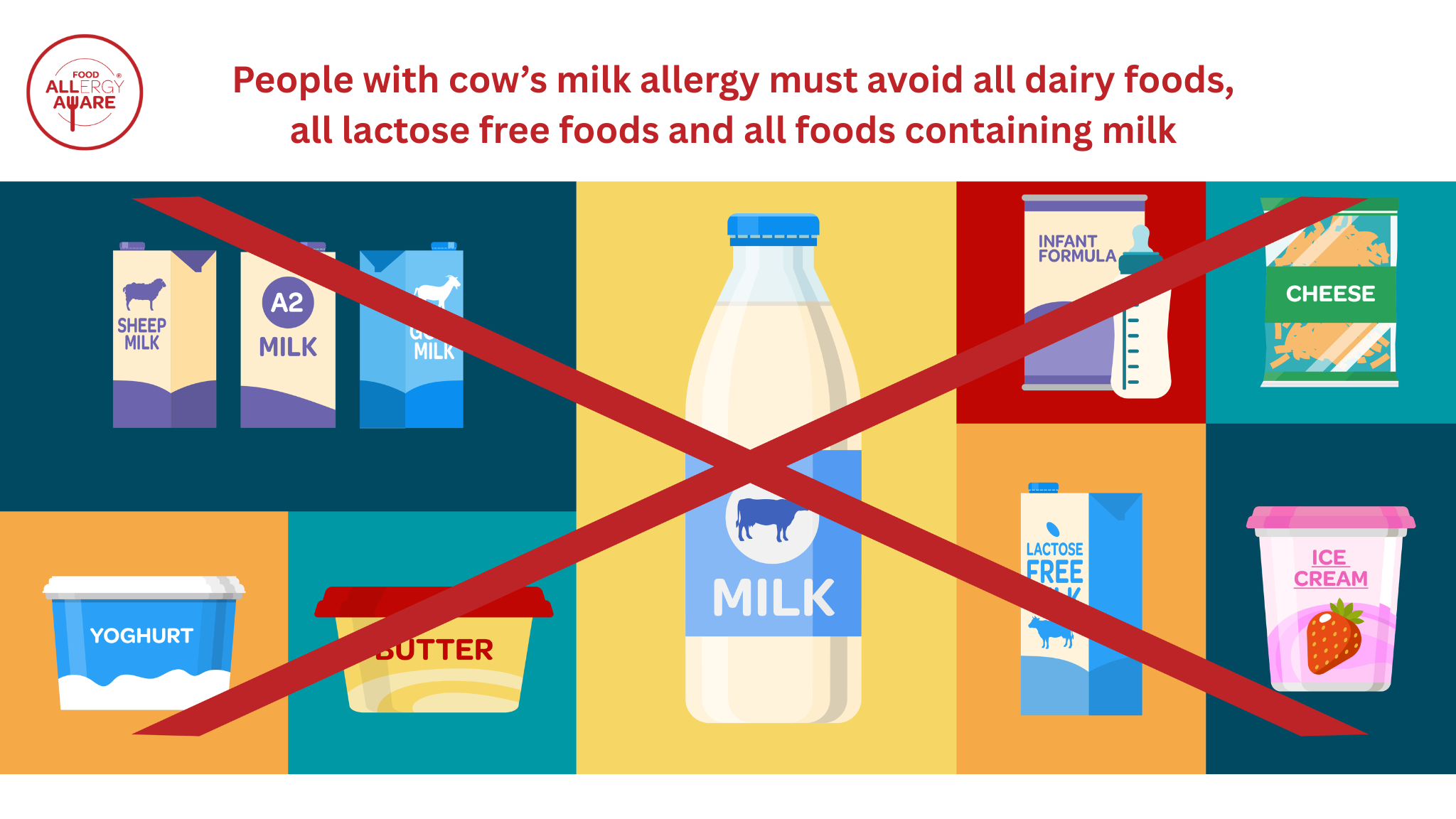
People with cow’s milk allergy must avoid all types of animal milk and lactose free milk.
Electronic menu coding
For milk allergy, all dairy foods, lactose free foods and foods with animal milk as an ingredient are coded as non-compliant.
Foods with statements like ‘may contain milk or ‘may be present: milk’ statements should be coded as non-compliant to dairy allergy.
Meal preparation for milk allergy
For patients and residents with milk allergy, care must be taken to make sure that milk is not an ingredient of their food.
Ingredients of all foods should be checked before preparing the meal to make sure milk is not an ingredient and that there are not ‘may contain’ statements. The ingredient should not be used if milk is stated on the label or on the product information sheet.
The food should be made in a way that prevents cross contamination of milk to the food allergy meal.

For milk allergy, be careful not to contaminate meals with milk.

About lactose intolerance:
Lactose is the sugar that naturally occurs in milk.
People with lactose intolerance cannot digest the sugar in milk and feel sick when they have too much lactose. People with lactose intolerance will not have a life-threatening reaction.
Lactose free products, like lactose free milk or lactose free yoghurt, have had the lactose sugar removed so people with lactose intolerance can tolerate them.
Lactose free products still contain milk protein. People with milk or dairy allergy will have allergic reactions to lactose free products.

People with lactose intolerance feel sick when they have lactose.
Food choices for people with lactose intolerance:
People with lactose intolerance can usually tolerate small amounts of lactose, so they only need to avoid large amounts of milk and yoghurt.
People with lactose intolerance can have lactose free milk, yoghurt and ice cream.
Foods with small amounts of lactose such as cheese are usually tolerated by people with lactose intolerance (lactose free cheese is not usually necessary).
Cross contamination with milk when preparing food is not a problem for people with lactose intolerance.
Electronic menu coding:
For ‘low lactose’ diet codes, meals with cheese and small amounts of milk can usually be coded as compliant. ‘Lactose free’ diet codes usually exclude all foods with lactose, depending on the level of restriction needed – this is decided by the site dietitian.
Need a quick refresher for staff on milk allergy and lactose intolerance?
See our video page for our two-minute animation ‘The difference between cow’s milk allergy and lactose intolerance’
Do you have any questions or comments about our article, or do you want to tell us how you manage food allergies in your facility to add to our best practice guidance? Contact us at info@nationalallergycouncil.org.au
Subscribe to the National Allergy Council newsletter for all the latest project updates:https://nationalallergycouncil.org.au/news#sub
* Ingrid Roche is a National Allergy Council Senior Project Officer leading the National Allergy Council’s Food Service Program, and an Accrediting Practicing Dietitian specialising in food allergy and food service.